



Mulembe Nation Poll December 2025
Release Date: Thursday, 8th January, 2026
Western Region Political Pulse: Voices, Priorities, and Power Shifts
As Kenya edges closer to the 2027 General Election, the Western region is emerging as one
of the country’s most politically consequential battlegrounds. Home to over 2.6 million
registered voters across Kakamega, Bungoma, Busia, Vihiga, and Trans Nzoia counties, the
region is navigating a period of political reawakening shaped by shifting alliances, rising local
leadership, and renewed demands for economic inclusion. The latest Infotrak Voice of the
People poll, conducted on 29th December 2025 among 600 respondents, reveals a
community that is increasingly issue-driven, politically plural, and open to new centres of
influence.
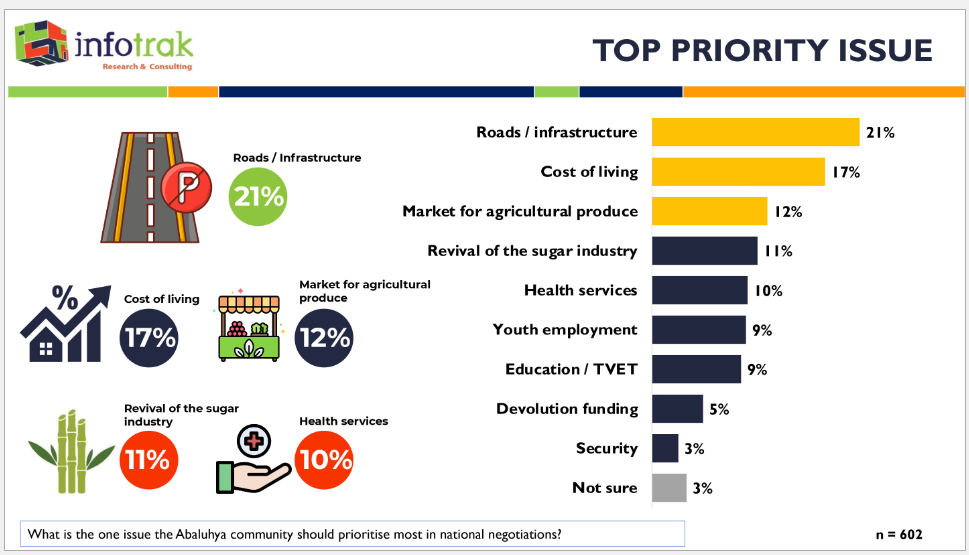
At the heart of the region’s political expectations is a strong demand for tangible
development outcomes. When asked to identify the single most important issue to be
prioritised in national negotiations, roads and infrastructure (at 21%) emerged at the top.
This priority issue was especially pronounced in Vihiga (39%) and Trans Nzoia (26%)
counties, reflecting the uneven pace of infrastructure development across the region. The
high cost of living followed closely at 17%, highlighting the pressure households continue to
face amid high food prices, fuel costs, and overall economic strain. Agriculture-related
concerns also featured prominently, with 12% prioritising markets for their agricultural
produce and 11% calling for the revival of the sugar industry, an issue deeply rooted in the
economic history of Kakamega and Bungoma counties. Healthcare services were prioritised
by 10% of the surveyed respondents, with Trans Nzoia county standing out at 22%, while
youth employment and education/TVET each attracted 9%, reflecting demographic
pressures in a region with a relatively young population. Overall, the findings paint a picture
of a community seeking practical economic relief.
Politically, the Western region is not a one-party zone. While the Orange Democratic
Movement (ODM) remains the single most popular party at 25%, its dominance is clearly
contested. The United Democratic Alliance (UDA) follows closely at 20%, signalling the
ruling party’s continued penetration into a region historically aligned to the opposition.
Notably, 7% of the surveyed respondents expressed their support for the Gachagua led
Democracy for Citizens Party (DCP), indicating growing openness to newer political
formations. Regional parties such as FORD–Kenya (4%) and DAP–K (2%) retain pockets of
loyalty, while 9% of of the respondents said they support no party at all, and 17% declined to
disclose their affiliation, a signal of political indecision. The high proportion of respondents
unwilling to disclose their party preference suggests that political loyalties in the region
remain fluid and highly susceptible to elite realignments ahead of 2027. County-level
analysis reveals sharp contrasts. ODM leads in Kakamega (29%) and Busia (27%) counties,
while UDA records its strongest showing in Bungoma (27%) and Vihiga (24%) counties.
On the presidential contest, President William Ruto would lead in the Western region with
25%, if elections were held today. Former Interior CS Dr. Fred Matiang’i follows with 15%,
drawing notable support in Busia (22%) and Vihiga (17%) counties. Trans Nzoia Governor
George Natembeya posts a strong 13%, positioning himself as a serious regional and
national contender. His appeal is especially pronounced in Trans Nzoia (16%) and Bungoma
(14%) counties. Other political leaders trail at a distance, with Kalonzo Musyoka at 8%, while
Babu Owino (3%), Gladys Wanga (2%), Rigathi Gachagua (2%), and David Maraga (2%)
register modest support. A significant percentage (25%) of voters in the region remain
undecided. The poll findings underscore a fragmented field in which no single candidate has
yet consolidated the Western vote.
Beyond electoral preferences, the Infotrak poll sheds light on who truly shapes political
opinion in the region. Trans Nzoia Governor George Natembeya stands out as the most
influential leader, as cited by 50% of the surveyed respondents. His influence cuts across
counties and demographics, peaking at 70% in Trans Nzoia county, reflecting both
incumbency advantage and his growing national profile. Veteran politicians in the region still
command respect. Prime Cabinet Secretary Musalia Mudavadi was mentioned by 32%,
while Senator Edwin Sifuna (31%) and National Assembly Speaker Moses Wetang’ula
(29%) remain key political players. Cooperatives and MSMEs CS Wycliffe Oparanya is
mentioned by 14%, and Eugene Wamalwa by 13%, pointing to a layered leadership
structure rather than a single dominant authority.
Perhaps the most telling insight emerges from the question of political “kingpinship.” Asked
who currently best champions the Western region’s interests, 36% named George
Natembeya, placing him well ahead of his rivals. Musalia Mudavadi follows at 18%, while
Moses Wetang’ula registers 14%. Other leaders, including Wycliffe Oparanya (8%) and
Edwin Sifuna (5%), trail behind. Yet, 10% of the surveyed respondents were of the view that
there is no clear kingpin in the region. The poll findings suggest a region transitioning from
elder-dominated politics to a more performance-based leadership model, where visibility,
assertiveness, and perceived advocacy matter more than legacy alone.
All in all, the Infotrak poll reveals a Western region at a political crossroads. Voters are
united on development priorities but divided on political vehicles. Traditional parties and
leaders still matter, but they now compete with emerging figures and shifting voter
expectations. With high levels of indecision across party support and presidential preference,
the region is poised to play a decisive role in shaping national coalitions ahead of 2027.
Any political actor seeking to win the region must therefore speak less about history and
more about delivery.
Raphael Mulwa,
General Manager, Infotrak Research & Consulting Limited

Leave a Reply
You must be logged in to post a comment.